
Data, Information, Knowledge: The Difference and Why it Matters
AEC professionals are asked to maintain trust across three fundamentally different types of content. Current systems don't distinguish between them. That's the problem.
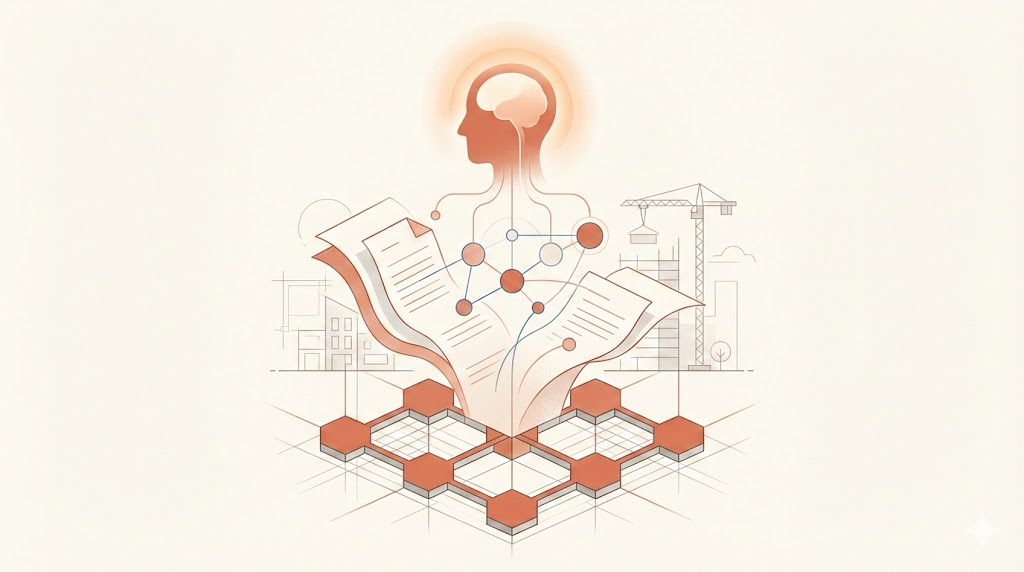
A structural engineer's specification for concrete mix design was issued last March. The general contractor's team located a PDF in email showing 4,000 PSI requirements. However, a subsequent addendum increased the requirement to 5,000 PSI. The field superintendent made decisions based on what he knew from three projects ago.
Three valid "truths" existed in different layers. None of them were wrong. They weren't connected, though.
I've watched this play out for 20 years, from construction sites to architecture practices to technology director roles. The problem surfaces the same way every time: someone makes a decision without enough context because the data, information, and knowledge layers aren't connected.
This is a story about a category mistake that costs the global construction industry $1.85 trillion annually, according to FMI and Autodesk's 2021 research. AEC professionals are asked to maintain trust across three different types of content, and current systems don't distinguish between them. The information exists. Finding it is one problem. Understanding whether to trust what you found? That's the deeper issue.
The Category Mistake
Ask any project team for their "single source of truth" and watch what happens. You'll get the specification document. The latest RFI response. The coordination model. Someone's memory of the design review meeting. All correct, but representing different kinds of correctness.
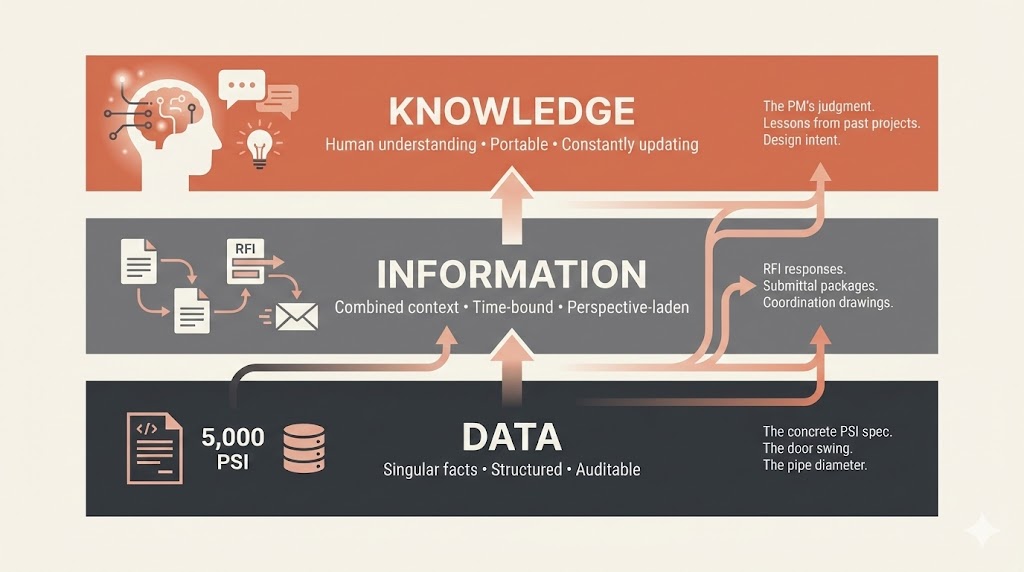
Data is singular, structured facts meant to be durable and auditable. The concrete PSI specification. The door swing direction. The pipe diameter. This is the historical record, the source-of-truth values that shouldn't change without formal documentation.
Information combines many data points into context, narratives, and documents. RFI responses. Submittal packages. Coordination drawings. Information is time-bound and perspective-laden. It carries interpretation. The same data appears in multiple documents, each telling a different part of the story (and often contradicting each other).
Knowledge is human-held belief and understanding. It exists in the moment, changes as new inputs arrive, and moves with people. "We solved this on the hospital project." The field superintendent's judgment call. The reasoning behind why that design decision was made. Knowledge lives in people. Portable, contextual, constantly updating.
Modern AEC work needs all three layers. Yet systems treat them interchangeably.
McKinsey's 2017 study of large construction projects found 98% of mega-projects suffer cost overruns exceeding 30%. One recurring factor: teams working from "different versions of truth."
Nobody was wrong. The truth they had access to lived in different layers without connection.
IFMA research shows 95% of data generated through construction is lost and not shared downstream to operations. A category problem, not a storage problem. Data becomes information becomes knowledge, but the connections disappear.
As one engineering firm described it: "Information silos are one of the most deeply-rooted coordination challenges in AEC." The silos exist between types of content that need different trust mechanisms, not just between departments or systems.
Why Traditional Solutions Fail
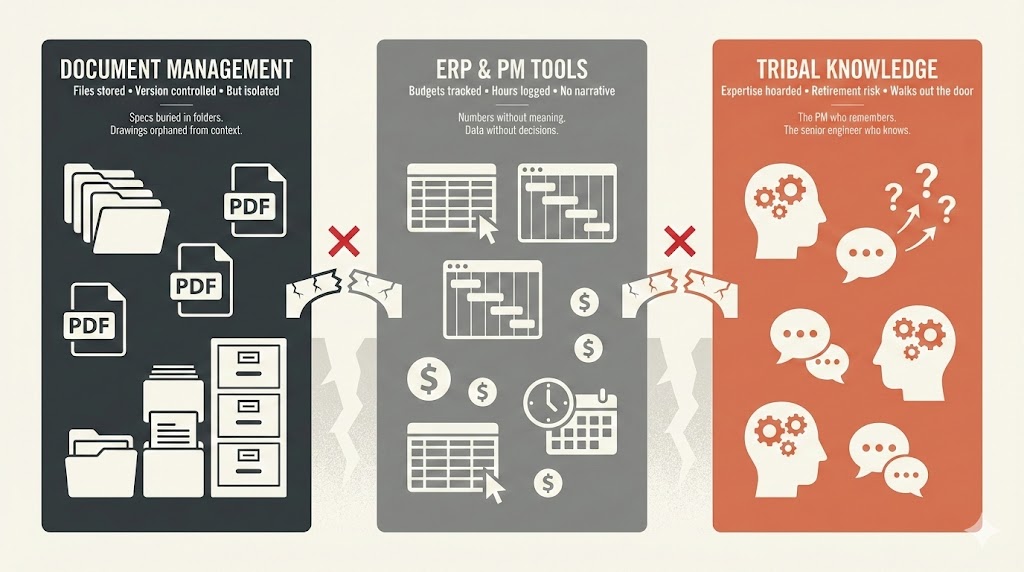
I've seen this pattern across dozens of firms. Document management platforms treat everything as information. Folders and files. Version numbers and permissions. This works well for storing documents, but it flattens data into PDFs and buries knowledge in meeting notes (or worse, leaves it undocumented).
The consequence? Version chaos. Teams spend an average of 5.5 hours per week hunting down revised drawings and project information, according to FMI research. The question "which version is current?" reveals the limitation. Information-centric systems can't reliably track data lineage across document boundaries.
Enterprise systems take a different approach: treat everything as data. Structured fields, database tables, transactional records. This works well for financial systems and project schedules. Handling the narrative context of an RFI response or the tacit knowledge of why a design decision was made? Those fall outside the system's capability.
The cost shows up in hard numbers. NIST estimated the annual cost of inadequate interoperability in the U.S. capital facilities industry at $15.8 billion, with $4.8 billion spent just on verifying and validating project information. Data systems can store the facts but not the reasoning.
Knowledge management platforms demand manual capture. Lessons learned databases. Project wikis. Post-project documentation templates. These work when someone has time to fill them out, which is approximately never.
When team members leave, the knowledge goes with them. Construction's 65% annual turnover rate (among the highest of any industry)and 41% of the workforce expected to retire by 2031 means firms face systematic institutional knowledge drain. The Center for American Progress found that replacing a highly-trained employee costs up to 213% of their salary and it takes two years for a replacement to match their predecessor's knowledge.
Systems optimized for one layer actively sabotage the others. SharePoint can't track data lineage (it's a document manager, not a lineage tracker). ERP systems can't capture contextual information. They handle numbers and dates. Reasoning behind decisions? No. Wikis depend on documentation discipline that doesn't exist under deadline pressure.
You're managing one problem treated as three.
What Operational Intelligence Offers
In our exploration of Operational Intelligence for AEC, we examined how scattered information creates access problems. The challenge runs deeper, though: maintaining trust across three different types of content.
Operational Intelligence maintains the distinction while creating the connections.
Data needs lineage. Show me the source document. Where did this value come from, who approved it, when did it change? A specification value becomes trustworthy when you can trace it back to the authoritative source.
Information needs version awareness. When an RFI response references "the structural drawing," which revision matters? What related documents exist? Trust comes from understanding relationships between documents and their evolution over time.
Knowledge needs narrative context. Show me the reasoning. Why was that decision made? What alternatives were considered? Knowledge transfers when you can see the decision trail, not just the final answer.
This doesn't eliminate the need for judgment itself. Engineers still decide if 5,000 PSI is appropriate. Project managers still coordinate. They make those calls with complete context, though.
Operational Intelligence provides explainable intelligence: showing you the data, the information context, and the knowledge reasoning so you can decide with confidence.
VIATechnik's analysis of AEC knowledge management identifies that "silos threaten knowledge management efforts." A 15-year academic review confirms AEC is uniquely "knowledge intensive" with specialized challenges around capturing expertise and transferring learning across projects.
The operational intelligence framework addresses this by keeping data traceable, information versioned, and knowledge connected to the people and decisions that created it.
What This Looks Like
The Concrete Spec Question
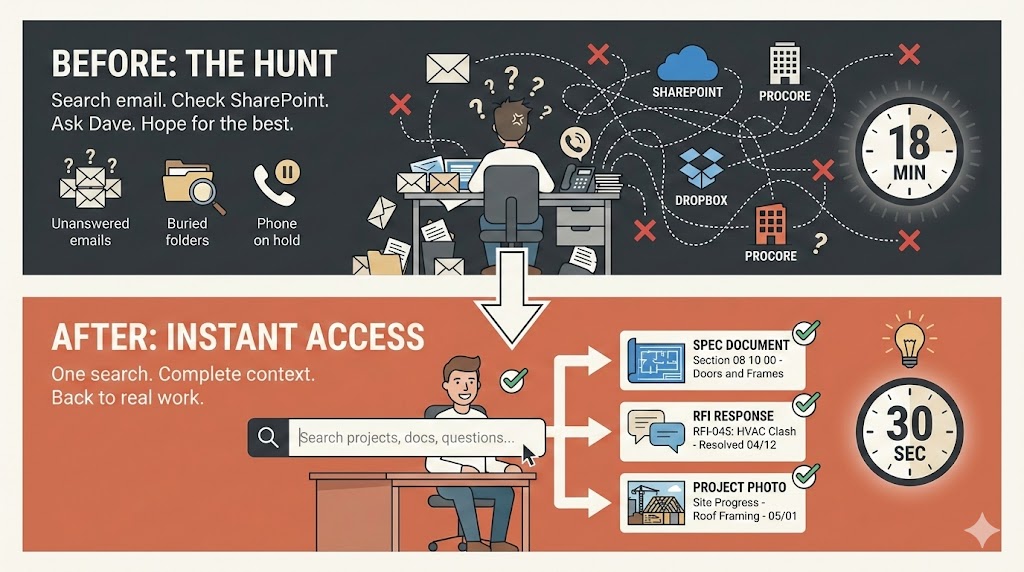
A project coordinator on a 280-unit residential project needs to verify concrete strength. Three sources exist: the original specification (4,000 PSI), an email addendum (5,000 PSI), and field notes referencing "same as Memorial Hospital project."
The coordinator spends 18 minutes hunting across email, file shares, and asking the superintendent who's in the field. Eventually she guesses based on the most recent-looking document. If wrong, rework.
Operational Intelligence changes this. Ask "What's the concrete spec for Building A?" Get the answer (5,000 PSI), with citations to the specification section, the addendum that changed it, and the geotechnical report that justified the increase. Trust, instantly.
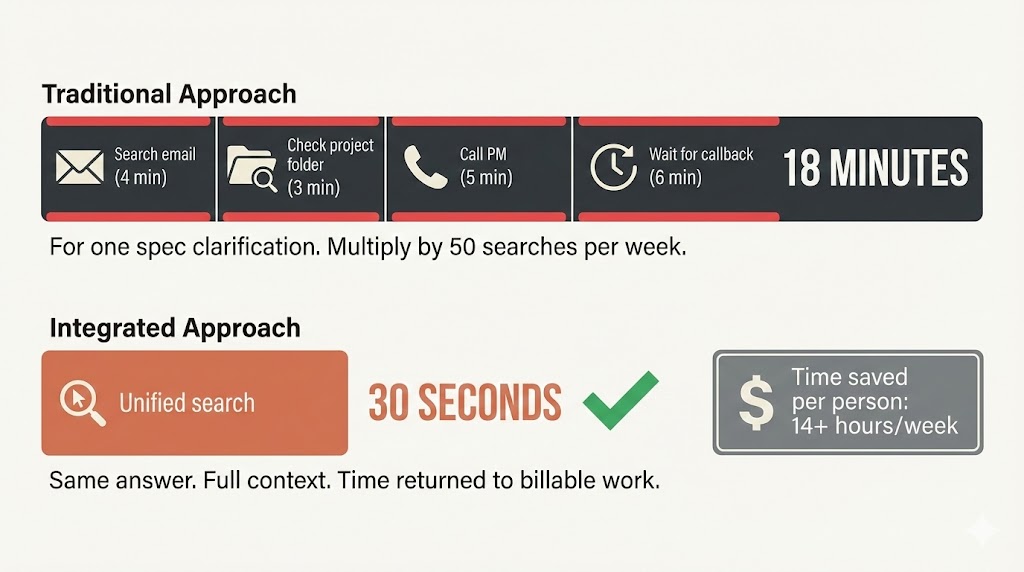
The Window Header Hunt
A structural engineer reviewing a coordination model notices a window header detail conflicts with architectural drawings. The RFI history shows three related questions, each answered by different team members, each referencing different drawing sets.
The Navigant Construction Forum's research shows RFIs take an average of 9.7 days to resolve, and 22% never receive answers. This is a leading indicator of project disputes. This information-layer failure creates coordination bottlenecks costing an estimated $1,080 per RFI in review time alone.
The engineer typically creates yet another RFI, hoping the right people see it and reference the right documents. The answer comes back in isolation, disconnected from related decisions.
Search "window header Building A" and see all three RFIs, the structural calculation that drove the original decision, and the architectural intent note explaining why it matters. Answer the coordination question with full context.
The Waterproofing Lesson
A project manager starting a new healthcare facility remembers the firm did a similar project two years ago. There was something important about waterproofing penetrations around medical gas lines. The PM who led that project left eight months ago.
The new PM searches file shares for "waterproofing," finds 47 documents, none labeled usefully. Eventually recreates the research from scratch. The lesson was learned once. Being learned again.
Search "waterproofing medical gas lessons learned." Get the specification section, the contractor's submittal response, the RFI thread where the decision was made, and the PM's project closeout note explaining why they chose that approach. The knowledge transfers without the person.
Broader Implication
When data, information, and knowledge stay connected, things change at the firm level.
Project handoffs become trustworthy. Data, information, and knowledge transfer together. New team members inherit understanding, not just files. The project manager who takes over mid-construction can see what decisions were made, why they were made, and what alternatives were considered.
Teams can scale. Firms grow without proportional increases in coordination overhead, preserving the efficiency that worked at smaller scale. Knowledge compounds as you grow.
ABC Wisconsin's analysis of construction workforce changes notes that with 40% of the workforce approaching retirement, the industry faces "brain drain" unless firms systematically capture and transfer knowledge. Operational Intelligence makes knowledge transfer systematic.
This is how operational work changes when layers connect.
Where to Start
In pilot conversations, firms often ask which layer to address first. The answer depends on where trust breaks first in your workflows.
I've found that mapping these breakdowns reveals the pattern:
Stop asking for a "single source of truth." Start asking which layer needs trust:
- Teams can't agree on specification values or design parameters? Data lineage problem.
- Coordination questions mean hunting through email and multiple document versions? Information relationship problem.
- Lessons learned don't transfer when people leave or projects close? Knowledge capture problem.
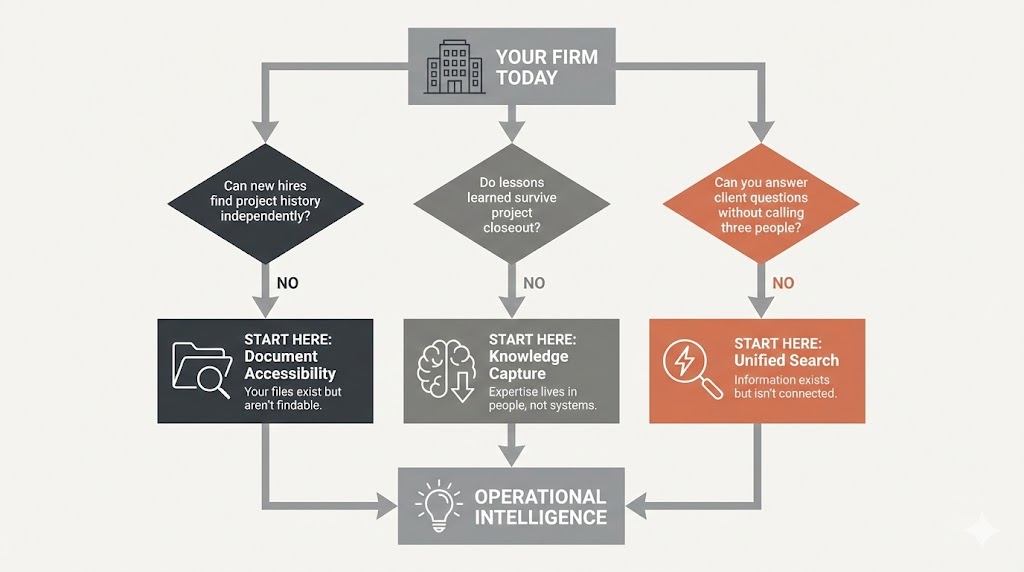
The operational intelligence challenge involves finding what exists, understanding what you found, trusting the context, and knowing why it matters. The knowledge exists. The information is somewhere. The data is recorded. Connection is what's missing.
The work involves connecting what already exists across the three layers that make decisions trustworthy.
References
- FMI Corporation & Autodesk. (2021). "Harnessing the Data Advantage in Engineering and Construction."
- McKinsey & Company. (2017). "Reinventing Construction Through a Productivity Revolution."
- International Facility Management Association. (2024). "Optimizing Building Management with a Lifecycle Approach."
- Schnackel Engineers. "Navigating Coordination Challenges in AEC: Tips for Efficient Project Delivery."
- National Institute of Standards and Technology. (2004). "Inadequate Interoperability: A Closer Look at the Costs." NIST GCR 04-867.
- BirdDogHR. (2017). "Why Knowledge Transfer is Key for Construction."
- Construction Dive. (2023). "Construction's Age Problem: A Foreboding Exodus of Experience."
- Wellhub. "How to Calculate and Reduce the Cost of Turnover."
- VIATechnik. (2024). "AEC Knowledge Management."
- ScienceDirect. (2023). "ICT for Knowledge Management in AEC: 15-Year Review."
- Construction Junkie. (2015). "The Cost of RFIs and Best Practices for Construction Professionals."
- Firmus. "RFIs Made Easier. For Everyone."
- Associated Builders and Contractors Wisconsin. (2018). "From Brain Drain to Knowledge Transfer."
The operational intelligence challenge involves finding what exists, understanding what you found, trusting the context, and knowing why it matters. Data records facts. Information carries context. Knowledge drives action. Operational Intelligence aligns all three.
If you're interested in seeing how this works with your firm's actual projects, request a pilot here.